Being the official export credit agency in Türkiye, Türk Eximbank helps Turkish companies engaged in goods and services exports, overseas contracting, and investment goods manufacturing and sales increase their share in international trade by extending them credit and credit insurance support.
Being a specialized bank in export financing, Türk Eximbank has embraced it as a primary goal to achieve its predefined targets associated with export finance rather than maximizing profit. However, care is taken to pursue policies that will safeguard a healthy financial structure in keeping with the responsibility of being a bank.
Türk Eximbank initiated the “Türk Eximbank Strategic Transformation Program” with the aim of more effectively supporting our country’s export strategies and flourish the foreign trade ecosystem in line with the worldwide best practices in collaboration with its stakeholders. Under this program, Türk Eximbank is transforming into a structure that proactively supports the exporters that generate high added-value for the national economy and pursue operations in line with our country’s export strategies. The Bank identifies exporters’ needs and challenges, and takes steps to expand its product and service array targeted at their needs and improve exporters’ experience of making use of Türk Eximbank support schemes.
In line with our Bank’s main goal, which is defined as “Augmenting the Impact of Eximbank Support Schemes to the Country’s Exports”, the Bank’s strategic priorities have been defined as increasing the support schemes provided for value-added exports, increasing the support schemes provided to SME exporters, and increasing the support schemes targeted towards green transformation.
strategic transformation program
Under the Strategic Transformation Program, Türk Eximbank is transforming into a structure that proactively supports the exporters that generate high added-value for the national economy and pursue operations in line with our country’s export strategies.
In a bid to achieve these strategic goals, our Bank’s strategic priorities for 2024 have been spelled out as follows:
- Continue with digitalization and technological transformation programs,
- Develop support mechanisms for exporters’ green and digital transformation,
- Continue with Eximbank’s credit and insurance business model transformation programs,
- Develop support mechanisms focused on high technology and added value,
- Introduce the foreign trade module and intermediate foreign trade transactions.
In 2023, under the Strategic Priorities and Transformation Program:
- Tracking systems that incorporate early warning indicators have been set up for effective monitoring of companies’ risks and for taking action before the risk materializes.
- Collaterals were diversified based on approaches that take into consideration exporters’ “creditworthiness” together with their “export worthiness”.
- Automated Limit Decision Models have been created in line with best practice examples with the aim of expediting the service to be rendered to exporters.
- Under Insurance Transformation, Actuarial Modeling Project entailing the pricing of insurance products has been completed.
- A structure has been created that will allow working with brokers in insurance/reinsurance; on the other hand, work is in progress for execution of marketing and sales activities of insurance policies also via insurance brokerage companies.
- A model has been created, which will calculate the carbon tax costs of exporters at high risk of being exposed to carbon border tax that will start to be implemented in 2026.
- Under Digital Transformation, Internet and mobile branch front-ends were revamped and user experience was improved. Screens and menus were simplified, thereby providing ease of use to exporters.
- The so-called “Customer 360” customer screens have been put into use, which will be used to instantly follow up the foreign trade data, financials, Türk Eximbank credit and insurance data of exporters that are our customers.
- Within the Scope of Product and Service Array Diversification, Participation-Based Export Receivable Insurance product has been launched for interest-averse exporters.
- In keeping with the focus placed on digitalization and automation efforts for bettering/shortening analysis and allocation processes and mitigating operational risks, associated system integrations have been finalized. System developments will be continued also in the future in line with the needs of our Bank and sector.
In 2024, our Bank will carry on with its activities and implementing its projects in line with our country’s export strategies and our Bank’s strategic priorities and goals.
Domestic Loans
Türk Eximbank supports exporters, export-oriented manufacturers, companies exporting FC-earning services, and international contractors/investors with short- and medium-long-term cash credit programs. The financing support that companies will need during the production process is extended both for pre-shipment and post-shipment periods through cash loans.
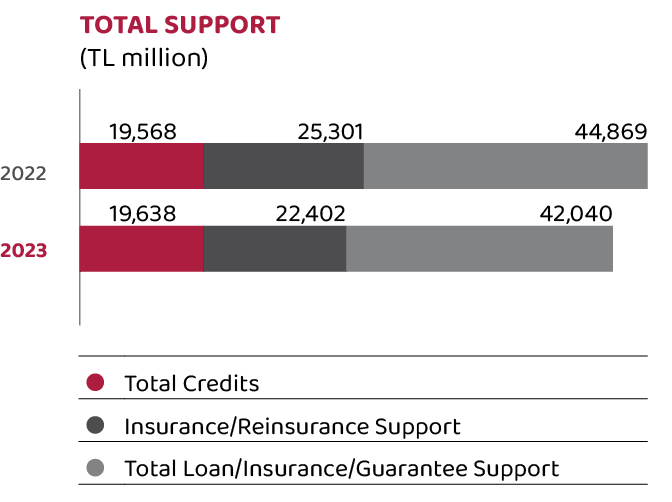
In 2023, short term loans extended by Türk Eximbank including maturity extensions totaled USD 16.3 billion, and medium-long term domestic loans totaled USD 3.3 billion.
USD 19.6 billion in total
In 2023, short term loans extended by Türk Eximbank including maturity extensions totaled USD 16.3 billion, and medium-long term domestic loans totaled USD 3.3 billion.
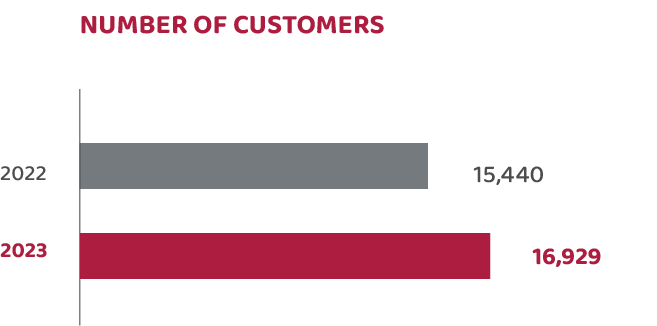
During 2023, 13,167 firms, which together accounted for a significant share of Türkiye’s total exports, benefited from Türk Eximbank’s loan programs.
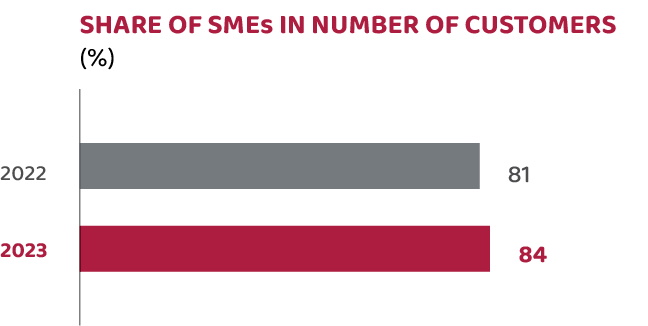
Priority was given to SMEs in lending, and TL credits were predominantly used for SME financing. As a result of additional funds provided to the SMEs, prioritization of their credit requests, and term extension support offered, TL 98.8 billion in local currency and USD 902.6 million in foreign currency were allocated in the form of credit support, and total SME credits amounted to USD 5 billion. Accordingly, 25.31% of the Bank’s credit support were allocated to SMEs.
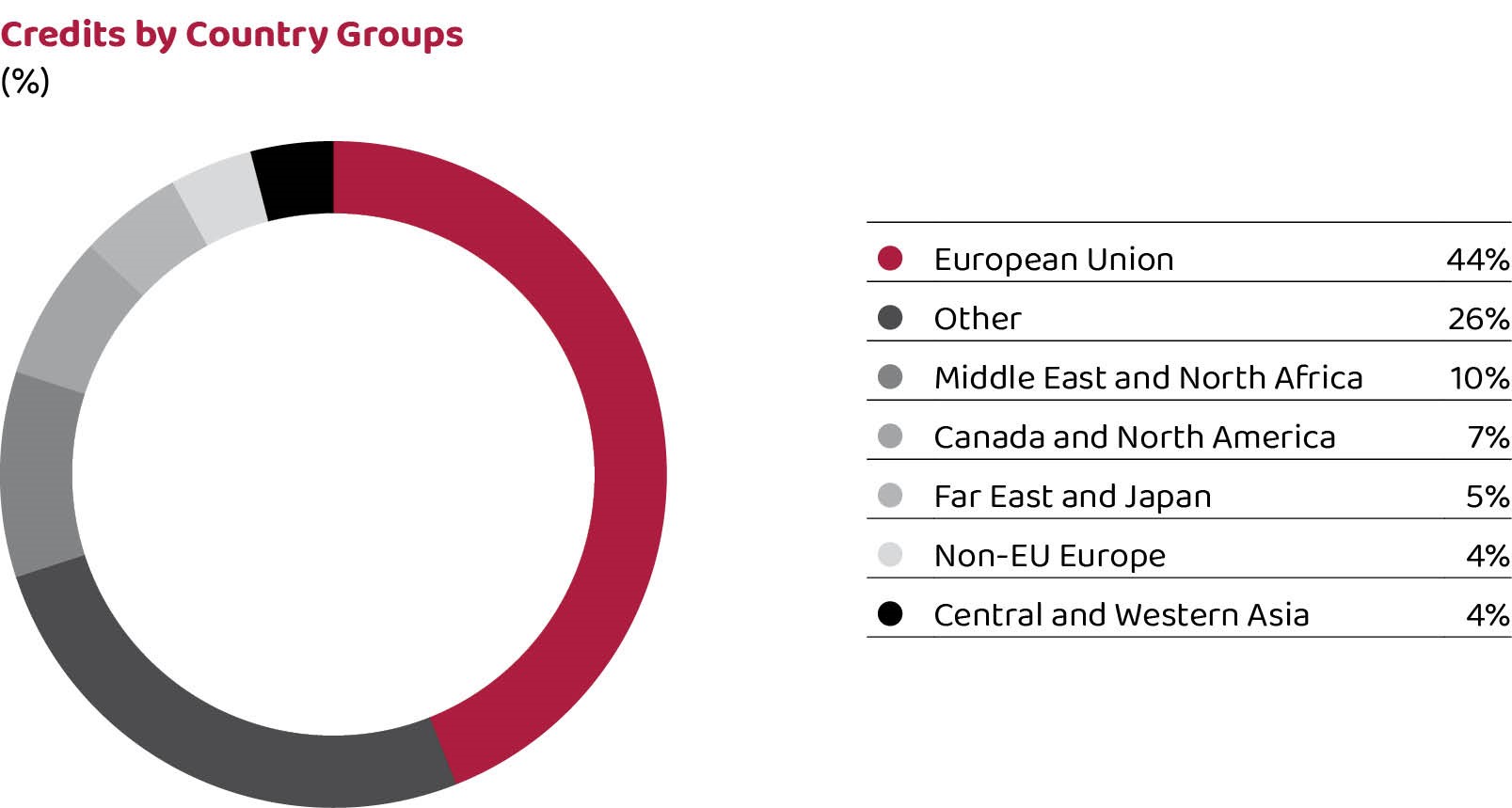
In the distribution of loans by countries to which Turkish exporters borrowing from our Bank undertake to make exportation to, EU countries lead with 44% share.
Logistics and transportation sector took the lead with 18% share in the sectoral distribution of loans.
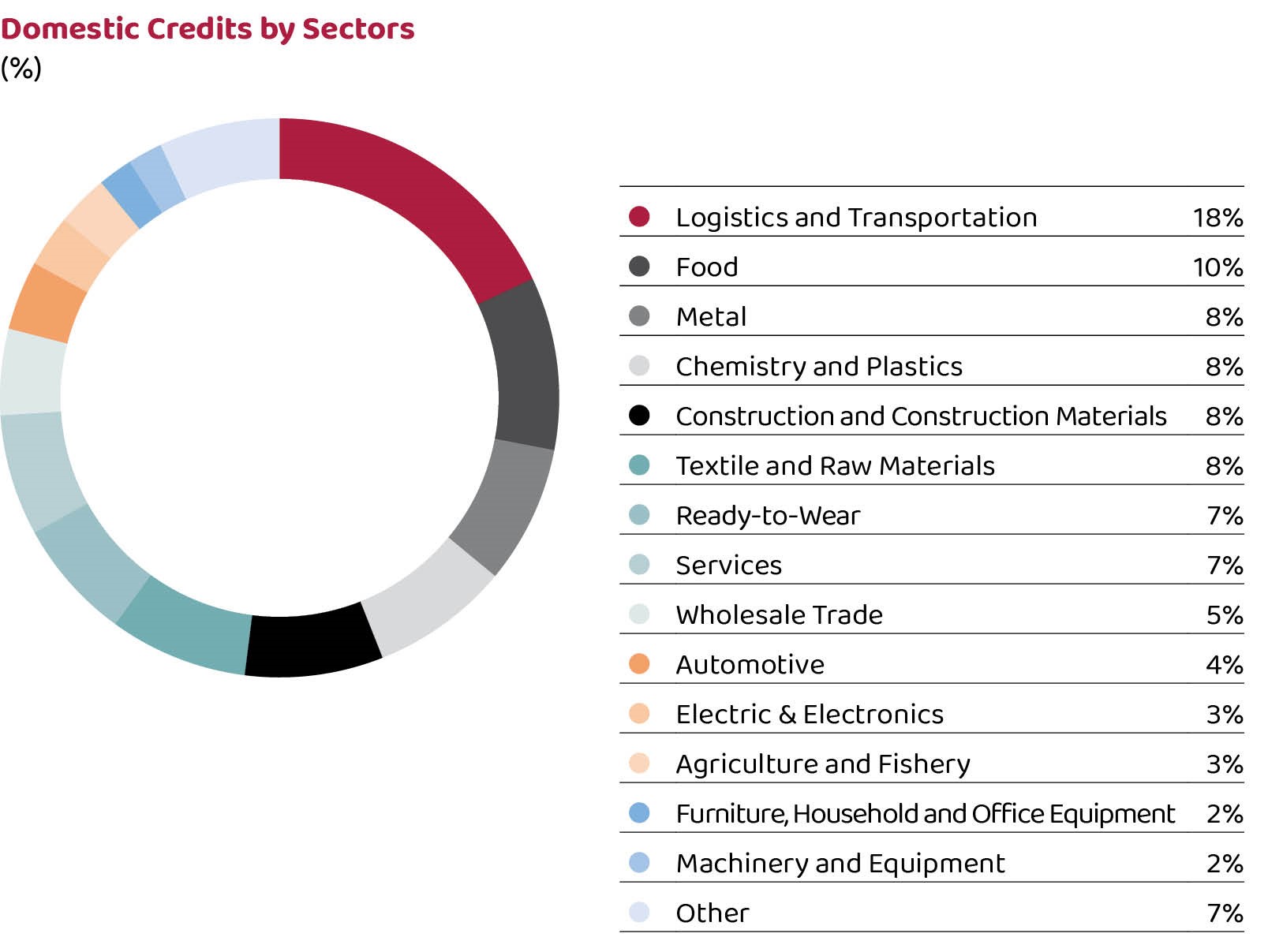
“Information and Communication Technologies”, “Paper and Forestry Products”, “Energy”, “Electrical Household Appliances”, “Healthcare”, “Retail”, “Glasswork” sectors are included in the OTHER category.
Recent Adjustments and Changes in Domestic Credit Programs
- Maximum maturity for short-term FC credits was applied as 720 days, whereas it was applied as 10 years for medium-long-term FC credits. Additionally, fixed-rate borrowing was made available for medium-long term FC credits.
- Maximum maturity for TL credits was set as 720 days and installment periods started to be implemented on quarterly basis.
- Instead of USD LIBOR, CME TERM SOFR rates started to be used for periodic interest rates to be determined in credit facilities disbursed/to be disbursed in USD terms.
- Maximum maturity for FC Pre-Shipment Export Credits and TL Pre-Shipment Export Credits was set as 720 days.
- In Pre-Shipment Export Credits disbursed via Participation Banks, the maximum terms were set as 720 days for TL loans and 540 days for FC loans.
- Used by companies that will make their first-ever credit application to our Bank for delivering their request and application documents, Web Application screens were improved and unified to be used for insurance and credits, thus facilitating firms’ access to our Bank’s services.
- Significant distance was paved in digitalization and automatic limit decision mechanisms have been devised for faster evaluation of exporters’ demands for financing.
- Suggested Risk Groups screens developed in 2023 systemically supported accurate identification of the risk group in which a firm belongs through automatic queries made from internal and external sources.
- Under the action-related articles of the Protocol Between the Government of the Republic of Türkiye and the Turkish Republic of Northern Cyprus for Improving Trade and Economic Cooperation signed by and between the Republic of Türkiye and the Turkish Republic of Northern Cyprus (TRNC), work was brought to completion for provision of financing support to service exporters residing in the TRNC by our Bank under the Pre-Shipment Export Credit program. As a result of the said work, FC disbursements were made available as an option in addition to TL disbursements.
- With the aim of diversifying financing sources under the Post-Shipment Rediscount Credit, BRT-sourced Turkish lira credit disbursements were initiated in addition to Bank-sourced FC disbursements.
- Under the Post-Shipment Rediscount Credit program, the practice of following up the risks not closed on maturity by the buyer or exporter in accounts receivables has been terminated; instead, a practice has been launched under which risks that could not be closed on maturity are reported to the Credit Risk Center.
- Standard letter of guarantee wording started to be used in credits disbursed by the Bank in return for a letter of guarantee issued by the CBRT or our Bank so as to guarantee uniformity for all transactions with the purposes of improving processes, preventing operational mistakes that may result from different wording options, and achieving alignment with Islamic banking principles and standards.
- The Bank joined in the “İGE Surety Portal” application from which member banks are able to obtain the information they may need to determine the creditworthiness of an exporter applying for surety, view the requested credit information, and deliver and revise their proposals.
- İGE Equity Surety Support Package upper limits were updated, and credit upper limits were increased to TL 30 million for SME beneficiaries and TL 60 million for non-SME beneficiaries. Furthermore, the lower limit of expert opinion assessments created for the evaluation of non-SME beneficiaries’ applications for TL 20 million and higher was increased from TL 20 million to TL 30 million, and disbursements started for applications that have been assessed within the scope of expert opinion.
- The web service integration has been completed, which was needed for reporting the collections pertaining to credits disbursed against İGE guarantee to İGE. İGE-guaranteed credit applications started to be accepted from companies that have reached the upper limit assigned to them in terms of the total amount of disbursements for the gaps created in their limits through collections.
- The “FC-Earning Services and Activities” definition in the “Portfolio Guarantee System Protocol for Equity Guarantee” signed by and between our Bank and İGE has been revised; accordingly, credits can now be disbursed against İGE guarantee to education, informatics, telecommunication, cloud and data center operation, entertainment and cultural services sectors and car-rentals abroad to non-residents.
- During 2023, exporters generating added value continued to be supported with İGE guarantee programs.
- The obligation to provide expenditure documents has been lifted in Bank-sourced credits disbursed against İGE guarantee.
- In December 2022, the first deal has been realized under the Rediscount Credit Based in Swap Agreements launched under CBRT Rediscount Credits, which were introduced with the aim of increasing international competitive strength of manufacturers and manufacturer/exporter firms producing goods for export and firms undertaking FC-earning services and activities, and of fulfilling their need for financing during their preparation for exportation, and the credit facility started to be disbursed broadly in 2023. Rediscount Credits Based in Swap Agreements made available to 67 firms in 2023 amounted to CNY 356 million (USD 49.2 million).
- The marketing activities are ongoing for the “Manufacturing Credit for Exporters Program”, which will be financed by low-cost special funds to be secured from overseas financial institutions and export credit agencies with the aim of financing our exporters’ raw material, intermediate goods and investment goods procurement.
- For the fulfillment of letter of guarantee needs of resident contractor firms’ non-resident subsidiaries, in which the former holds 50% or higher share, “Overseas Letter of Guarantee Program Implementation Principles” have been modified for satisfying their need for the issuance of a letter of guarantee in favor of their non-resident subsidiaries in which they hold 50% or higher share from out of the non-cash credit lines allocated by our Bank to the resident company.
- An agreement has been signed on 13 December 2022 to obtain funds in the amount of EUR 150 million from the Council of Europe Development Bank (CEB) with the guarantee of the Republic of Türkiye Ministry of Treasury and Finance so that our Bank will be able to finance the operating capital and investment finance needs of manufacturers that produce final goods for exportation and export these goods via an exporter although they are not in the capacity of an exporter or manufacturer/exporter or exporter and of companies undertaking FC-earning services and activities with medium-long term facilities.
- Our Bank broadened the scope of its products and services in view of the needs that companies engaged in value-added and high-technology exportation have in accessing financing within the frame of the strategic transformation it has launched under its export-oriented growth strategy. To this end, collaterals have been diversified based on approaches that take into account exporters’ “creditworthiness” together with their “export worthiness”. Accordingly, alternative collateral types generally accepted in the banking sector started to be accepted also by Türk Eximbank, including securities pledge, guarantees by guarantee agencies such as the Credit Guarantee Fund (KGF) and İGE, mortgage, guarantees by real or legal persons, as well as bank letter of guarantee and our Bank’s Export Receivables Insurance Policy.
- The Board of Directors passed a decision to be included in the “İGE Centennial Treasury Support Package” with the aim of offering diverse collaterals to our exporters under the protocol signed by and between İGE and the Republic of Türkiye Ministry of Treasury and Finance to enable İGE to provide Treasury-backed guarantee.
- The KGF export support package is intended to support working capital requirements of exporters to help them increase their export volumes and promote value-added exportation.
- Murabaha (cost-plus financing) agreement and implementation principles aimed at business finance and financing of finished investment goods have been revised in accordance with the requirements of the Central Advisory Board Murabaha Standard and the BRSA, and the product’s name was changed from Participation Finance Business Loan to Murabaha Finance (Sale with Profit Statement).
- As part of the efforts for alignment with the Central Advisory Board Murabaha Standard, BRSA requirements and Islamic Banking Principles and Standards, Work Financing program has been created in accordance with the Islamic Banking Principles and Standards to fulfill financing demands for goods to be produced or unfinished goods.
- Under the Overseas Letter of Guarantee Program, correspondent banks have been contacted to get quotations for our exporters’ demands for letters of guarantee.
Actualizations on the basis of Domestic Credit Programs (USD billion)
Direct Disbursements |
19.1 |
Bank-Sourced Loans |
6.6 |
CBRT-Sourced Loans |
12.5 |
Intermediary Bank/Institution Loans |
0.5 |
Loans Extended via Intermediary Banks/Financial Institutions |
0.5 |
TOTAL |
19.6 |
* A minimum portion of 30% of the credit lines allocated to intermediary banks must be disbursed to SMEs; accordingly, loans worth USD 0.493 billion were allocated to SMEs through intermediary banks during 2023 (91%).
Buyer Loans Programs
International Loans Programs, under which projects undertaken abroad by Turkish contractors and the buyers (public and private) of Turkish goods in foreign countries, are intended to increase Türkiye’s exports, diversify the goods and services exported, acquire new markets for export goods, increase the share exporters get from international trade, and provide competitive strength and assurance to Turkish firms in international markets. All supports provided under International Loans are in the nature of “buyer’s credits” and debtors are directly governments, the buyer country’s state-guaranteed public institutions or overseas/domestic banks within the allocated limits.
To add momentum to International Loans Programs and in turn, to increase exports of Turkish goods and services, revolving loan agreements are made with non-resident banks that the Bank deems reliable for overcoming the hardships borrowers experience in getting a state guarantee and for extending support to the private sector’s transactions, as well.
USD 46.8 million
The loans disbursed under International Loans Programs in 2023 amounted to USD 46.8 million.
In this context, negotiations are ongoing for potential transactions within the frame of the credit lines allocated to two multinational banks (the African Export-Import Bank and the Eastern and Southern African Trade and Development Bank), as well as commercial banks operating in various countries.
The stagnation that resulted from the COVID-19 pandemic that took the whole world in a tight grip as of the first quarter of 2020 partially continued in 2022 although at a lessening degree; the war that broke out in February 2022 between Russia and Ukraine, our two important partners in trade which are our neighbors along the Black Sea, led to worldwide price increases particularly in energy and agricultural goods; the measures adopted by central banks that manage the reserve currencies for fighting the resulting inflation pushed interest rates up, which have resulted in high borrowing costs since 2022 for developing countries that are more vulnerable as compared to developed economies. The interest rates offered to prospective borrowers under the International Loans Programs that were found to be high in conjunction with the elevated borrowing costs on one hand, and significantly restricted borrowing facilities available to countries our exporters and contractors pursue activities in under these countries’ agreements with international agencies resulted in limited buyer credit demands for overseas contracting and exports transactions. Despite all the negative circumstances mentioned above, credits disbursed under the International Loans Programs amounted to USD 46.8 billion.
Under the existing overseas bank analysis and credit line allocation methodology, a total credit line of USD 422 million was allocated to 8 banks, 3 of which are multinational banks. Hence, the transaction coverage expanded over 54 countries via the member countries of multinational banks.
Besides credit disbursements, letters of intent continued to be issued, which contribute to their undertaking new projects abroad particularly when developing business in risky markets. During 2023, 12 Letters of Intent were issued for financing projects and goods exports planned to be undertaken by Turkish companies in a total of 7 countries in Africa, Asia and Europe. If the projects/transactions covered by the letters of intent provided to the firms are actually carried out, exports of goods and services from Türkiye is anticipated to amount to USD 2.1 billion.
In addition, our Bank participated in the meetings of the Environment Practitioners Group, Country Risk Experts, Technical Experts Group and Shipbuilding Working Group organized under the OECD, and made contributions for the formation of our country’s position and opinions.
Actualizations on the Basis of Projects/Deals under Buyer Credit Programs
Within the scope of the State-Guaranteed Buyer’s Credits program, financing in the amount of USD 46.8 million has been provided in 2023 to the buyers of various goods and equipment exported from Türkiye under the credit agreement for the amount of USD 200 million signed in 2018 between the Tunisian Ministry of Development, Investment and International Cooperation and our Bank.
The Paris Club’s press release of May 2023 announced that the Creditors Committee that includes our country has been established for the state of Ghana’s request for debt restructuring under the Common Framework. Our Bank attends the meetings of the Paris Club Creditors Committee along with the officials from the related Ministry, and the developments about that country are closely monitored.
On the other hand, USD 138.3 million has been collected from our debtors during 2023 within the scope of International Credit Programs.
USD 22.4 billion in total
During 2023, shipments with a total worth of USD 22.4 billion were insured under Short-Term Export Credit Insurance, Short-Term Domestic Credit Insurance and Medium-Long Term Export Credit Insurance.
Receivable Insurance
Türk Eximbank boasts being the entity that has initiated export receivables insurance in Türkiye and that has established awareness of the need for export insurance. Initially introduced to cover solely short-term export receivables against commercial and political risks, the export credit insurance system’s scope was broadened in time, and medium/long-term exports of goods were also included within insurance coverage with the Specific Export Credit Insurance Program.
Through its insurance programs, the Bank provides insurance coverage for exports to countries covered under the insurance against losses arising from commercial and political risks arising from the importer firm and importer’s country. In addition, domestic receivables of exporters are protected against commercial risks also through domestic credit insurance as well as export credit insurance.
Moreover, obtaining a credit from financial institutions is facilitated by putting up credit insurance policies as collateral.
During 2023, shipments with a total worth of USD 22.4 billion were insured under Short-Term Export Credit Insurance, Short-Term Domestic Credit Insurance and Medium-Long Term Export Credit Insurance.
In 2023, reinsurance continued to be obtained from domestic and overseas companies for 60% of commercial and political risks (pertaining to OECD non-member countries) assumed within the frame of receivable insurance programs.
In 2023:
- In order to satisfy our exporters’ current needs and demands, the scope of FC-earning service receivables that can be covered under our Bank’s Service-Added Short-Term Export Credit Insurance Policy has been expanded.
- Short Term Export Credit Insurance, Short-Term Domestic Credit Insurance, Service-Added Short-Term Export Credit Insurance and Participation-Based Receivable Insurance Policies have been revised.
- Momentum was given to creation of Islamic Banking products, and Participation-Based Export Receivables Insurance Program has been introduced.
- Türk Eximbank Country Risk Classification used in the pricing of export credit insurance products have been revised relying on the work carried out in 2023.
- Actuarial pricing was worked on for Short-Term Receivable Insurance products; additionally, work was initiated for the management of insurance premium discounts and strategic discount formulation.
- Preliminary meetings were held with various insurance brokers that are competent in Receivable Insurance with the aim of letting the marketing and sales activities of our Bank’s Receivable Insurance Policies be carried out via insurance brokerage firms, in addition to our Bank’s branches and Regional Insurance Marketing and Coordination units.
Short-Term Export Credit Insurance
The Short-Term Export Credit Insurance Program provides cover for all shipments of exporters up to 360 days against commercial and political risks.
Offered since 1989 by Türk Eximbank, Short-Term Export Credit Insurance became a service recognized and extensively used by exporters in time. As a result, 6,857 export firms were making use of the service as of 2023 year-end.
Under the program, exports worth USD 19.7 billion was provided with insurance cover in 2023, and premiums in the amount of USD 64.9 million were collected for the insured shipments.
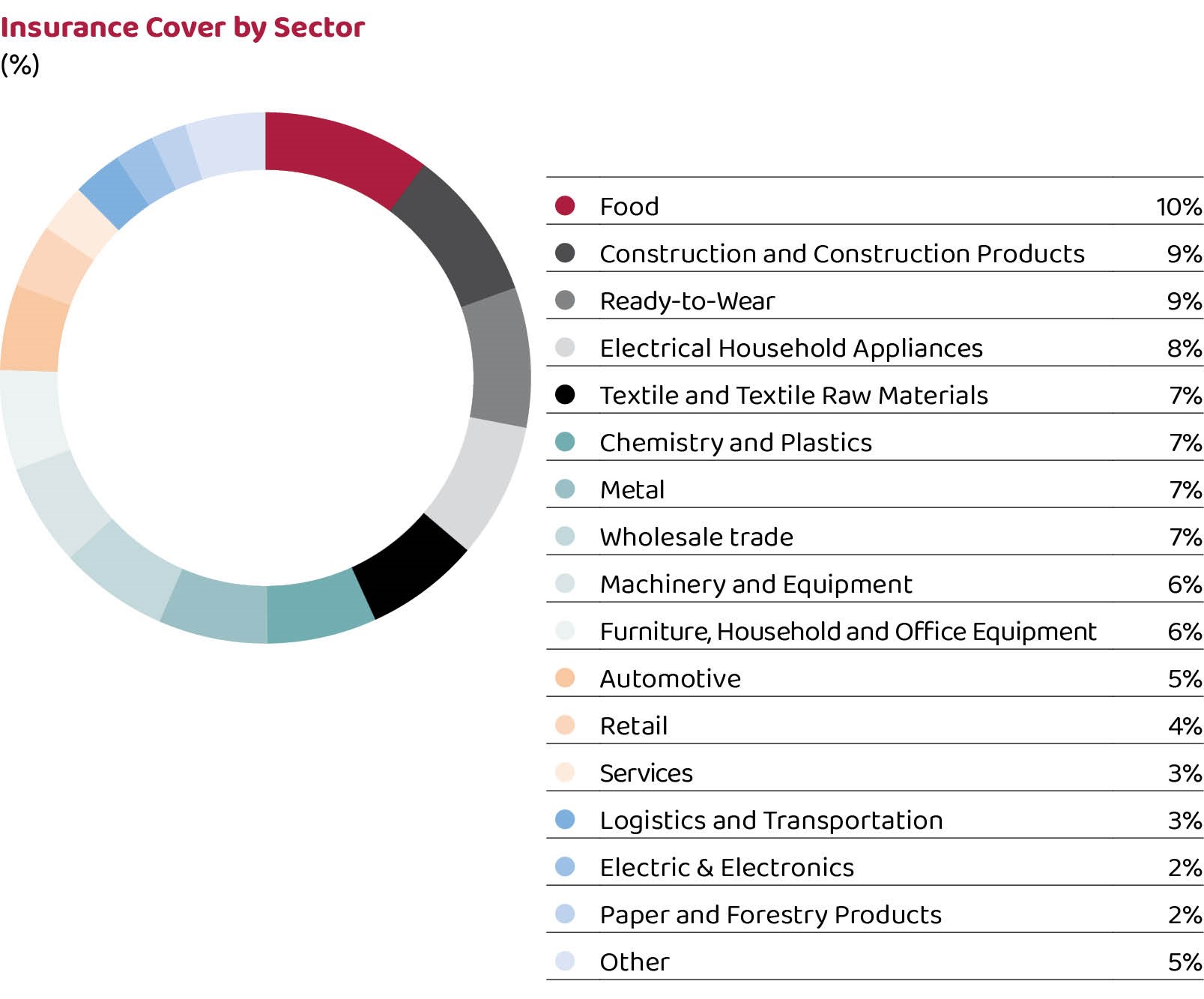
In the sectoral distribution of insured shipments, food industry took the lead with 10% share, followed by construction and construction products industry and metal, ready-to-wear and garment industry with 9% share each.
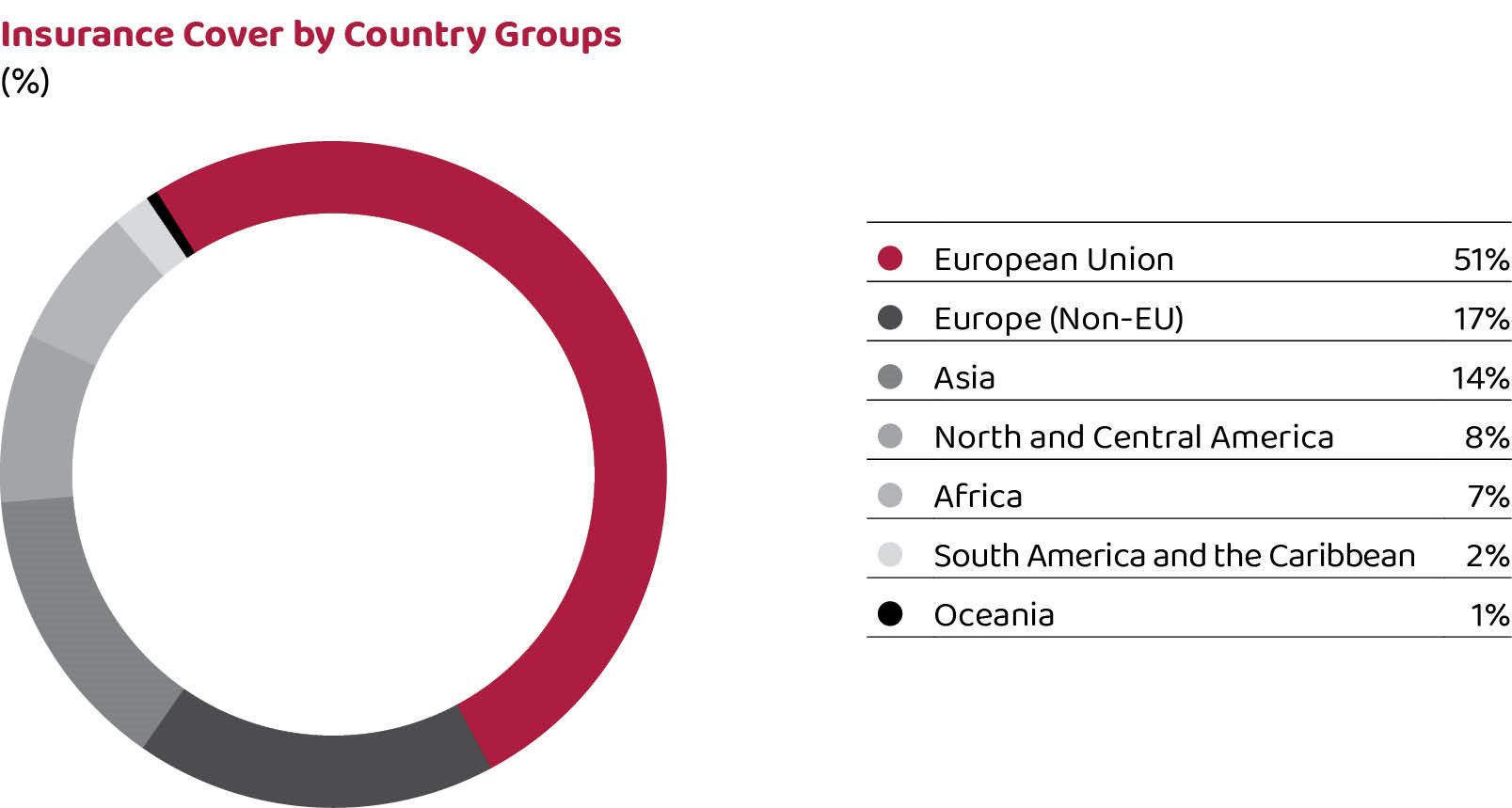
The regional distribution, however, is topped by European (European Union and non-EU combined) countries with 68% share, whereas Asia ranked second with 14% share and North and Central America ranked third with 8% share.
The number of buyers granted consistent limit under the Short-Term Export Credit Insurance Program is 53,190.
In 2023, Türk Eximbank indemnified USD 24.9 million in losses, which arose from shipments to various countries and the receivables from which could not be collected when due, under the Short-Term Export Credit Insurance Program. In the same period, Türk Eximbank recovered a portion of USD 6 million out of the losses indemnified before.
Short-Term Domestic Credit Insurance
Short-Term Domestic Credit Insurance program for exporters and their group companies is another area of insurance that Türk Eximbank is engaged in.
With this program, receivables of exporters and group companies having a Short-Term Export Credit Insurance Policy from credit-sale shipments up to 360 days, which are associated with their domestic operations, are insured against commercial risks within specified limits.
As of year-end 2023, 159 firms’ shipments worth USD 2.7 billion were insured. Premiums in the amount of USD 6.3 million was collected for the shipments insured, while claims paid amounted to USD 35 thousand.
Specific Export Credit Insurance
Exporters’ receivables arising from shipments born out of a single sales contract with a maximum term that is defined in line with OECD rules are provided coverage with Specific Export Credit Insurance. Under the program, sales through overseas subsidiaries can also be insured besides exports of Türkiye-origin investment goods and services of export companies.
Other Insurance Programs
Other insurance programs offered by Türk Eximbank are Participation-Based Receivable Insurance, Pre-Shipment Risk Insurance, Financial Institutions Buyer’s Credit Insurance, Overseas Contracting Services Political Risk Insurance and Letter of Credit Confirmation Insurance programs.
The Participation-Based Receivable Insurance Program provides cover for export receivables with a maximum maturity of 360 days arising from exporters’ goods sales aligned with Islamic Banking Principles and Standards to non-resident buyers against commercial and political risks
Pre-Shipment Risk Insurance Program, another product aimed at exporters, provides insurance coverage for potential losses directly associated with production costs that an exporter might sustain in the event that the order is cancelled by the buyer during the production phase in connection with commercial and political risks.
Overseas Contracting Services Political Risk Insurance Program aimed at contractors, on the other hand, provides insurance coverage for potential losses Turkish contractors may sustain in relation to their overseas projects as a result of political risks.
Financial Institutions Buyer’s Credit Insurance offered for banks provides insurance coverage for losses sustained by the creditor due to the borrower’s non-repayment of the buyer’s credits provided by domestic and overseas financial institutions for exportation of Turkish goods and services.
Letter of Credit Confirmation Insurance Program, on the other hand, insures losses sustained by the confirming bank in the event that letters of credit opened by an overseas issuing bank, to which the confirmation of a domestic bank is added, shall have not been paid by the issuing bank due to commercial and political risks.
Financing and Treasury
In 2023, Türk Eximbank secured funds in the amount of USD 4.3 billion from international markets and an additional USD 1.3 billion within the scope of funding from treasury transactions (repurchase agreements, TRS, money swaps, borrowings) and kept offering low-cost financing facilities with various maturities from its fund stock maintained at USD 9.3 billion level, excluding CBRT funds. The Bank’s total fund stock including TL credits and USD 9.5 billion CBRT rediscount facility was registered as USD 18.8 billion. On the other hand, principal repayment by the Bank amounted to approximately USD 3.3 billion during the reporting period.
USD 9.3 billion in total
In 2023 Türk Eximbank kept offering low-cost financing facilities with various maturities from its fund stock maintained at USD 9.3 billion level, excluding CBRT funds.
Developments Regarding the Capital
As approved at the Extraordinary General Assembly convened on 12 January 2017, Türk Eximbank switched to the “Registered Capital System” in accordance with the Turkish Commercial Code no. 6102. The decision was registered with the trade registry and promulgated in the Turkish Trade Registry Gazette issue 9252 dated 30 January 2017.
As a result of the Bank’s Ordinary General Assembly convened on 21 July 2023, the Bank’s registered capital ceiling was increased from TL 30 billion to TL 50 billion.
Furthermore, the cash capital injection of TL 6.8 billion realized by the Republic of Türkiye Ministry of Treasury and Finance in July 2023 increased our Bank’s paid-in capital from TL 13.8 billion to TL 20.6 billion, thus maintaining the solid capitalization.
Borrowing Transactions
TL funds derived within the scope of paid-in capital and interest collections were used for funding almost the entirety of TL loans disbursed in 2023, excluding Rediscount Credits.
The details about the Bank’s borrowings in 2023 are presented below:
- Türk Eximbank heavily utilized the promissory note rediscount facility of the Central Bank of the Republic of Türkiye (CBRT). As of 31 December 2023, the balance of these resources including TL Rediscount Credits amounted to USD 9.5 billion.
- With the sustainability-linked syndicated loan deal carried out in May, Türk Eximbank secured a fund with a 1-year maturity in the total amount of USD 674 million, which consists of EUR 522 million, USD 54 million and CNY 325 million and which was participated by 24 international banks. In November, the Bank renewed the syndicated loan with a roll-over ratio of over 100%, again tied to sustainability criteria, and obtained a 1-year source of USD 658 million in total, which consisted of EUR 496.2 million, USD 79 million and CNY 350 million and which was participated by 21 international banks.
- The Bank obtained funds worth approximately USD 2 billion from international capital markets on the back of Eurobond deals whose issuances were completed in January and October 2023 and private placements. Moreover, the bond issuance Türk Eximbank carried out by early 2023 was granted “Quasi-Sovereign/GRE Bond Deal of the Year” award at the “Bonds, Loans & ESG Capital Markets CEE, CIS & Türkiye Awards”, a prestigious and respected recognition programs in the finance sector organized by the GFC Media Group.
- In August, Türk Eximbank secured a USD 277 million-fund under the murabaha syndicated loan agreement coordinated by the Islamic Trade Finance Corporation (ITFC).
- A fund in the amount of EUR 75 million was secured on 16 January 2023 as the first tranche of the EUR 150 million facility with a maximum term of 7 years signed with the Council of Europe Development Bank (CEB) on 13 December 2022 under the guarantee of the Republic of Türkiye Ministry of Treasury and Finance.
- The amount of loans secured from international banks totaled USD 626 million in 2023.
- Furthermore, the Bank secured USD 1.3 million in funds secured through treasury transactions (repurchase transactions, TRS, borrowings). As at year-end 2023, the existing fund stock is in the order of USD 515 million.
Fund Management Activities
Türk Eximbank kept a close eye on national and global developments, and paid maximum attention to liquidity, interest rate and exchange rate risks management, taking into account such issues as interest and exchange rates, global macroeconomic conjuncture, and return-cost balance in 2023.
As part of liquidity management, funds generated through currency swap, repo transactions and borrowings from money markets were invested in CBRT, Takasbank Money Market and interbank market, and high interest income was achieved.
The liquidity ratio in total assets managed by the Treasury Department, which was kept within the legal limits set out in the BRSA Regulation Concerning Measurement and Evaluation of Liquidity Adequacy of Banks, averaged 5.5% throughout 2023, and the share of securities portfolio in total assets was 2.8% in average.
In the reporting period, the Bank carried on with short- and long-term swap operations for cash flow management and assets and liabilities harmonization purposes. Türk Eximbank’s swap operations in 2023 aimed at managing the Bank’s FX position and cash flows more effectively and ensuring asset-liability harmony, as well as for arbitrage purposes, were worth USD 20.3 billion, of which USD 19.3 billion was in short-term and USD 1.02 billion was kept in long-term.
Hedge accounting continued to be implemented in order to prevent fluctuations on the income statement resulting from interest and cross-currency swaps carried out for harmonizing FC funds secured from international markets through bond issuances or other borrowings with the assets composition.
Derivatives (forwards, options and swap transactions) and FX trading transactions continued to be offered with the purposes of protecting exporters’ competitive strength in global markets, and strengthening their ability to manage the exchange rate risk stemming from FC receivables and FC liabilities and the interest rate risk that might arise from interest rate fluctuations.
International Relations
over 60 agreements
There are over 60 agreements of various content that Türk Eximbank signed with the export credit agencies of 40 countries, as well as multilateral financial institutions.
There are over 60 agreements of various content that Türk Eximbank signed with the export credit agencies of 40 countries, as well as multilateral financial institutions. The Bank sustained its close cooperation with these institutions and its efforts for signing new agreements also in 2023.
In this framework, our Bank signed Memoranda of Understanding (MoU) with China Eximbank, one of the official export credit agencies of the People’s Republic of China, and ECG, the export credit agency of Greece, targeted at co-financing the transactions that the companies of the two countries will undertake in third countries, as well as mutual sharing of knowledge and experience. Moreover, the MoUs between our Bank and multilateral financial institutions, namely Economic Community of West African States (ECOWAS) Bank for Investment and Development (EBID) and Algeria’s official export credit agency CAGEX, have been renewed.
In 2023, work continued to add new ones to the reinsurance agreements signed in earlier years with USEXIM (USA), UKEF (UK), BPIFrance (France), EKF (Denmark), OeKB (Austria), MEHIB (Hungary) and EKN (Sweden) to enable co-financing of projects that Turkish exporters and contracting firms will undertake in third countries in cooperation with foreign firms, and thus, contribute to increase their competitiveness.
Türk Eximbank attended and contributed to the meetings of OECD Export Credits and Credit Guarantees Group, which was established to facilitate information and opinion exchange between member countries’ related institutions regarding officially supported export credits and of which Türkiye became a permanent member in April 1998, particularly in the negotiations for revising OECD Guidance on Environmental and Social Impact Assessment.
The Bank participated in and contributed to the negotiations for finalizing the modernization of the Arrangement on Officially Supported Export Credits which is addressed in the meetings of OECD’s Participants to the Arrangement on Officially Supported Export Credits, within which the Bank acquired “invited participant” (observer) status in 2006 and “participant” status in 2018, and for supporting climate-friendly projects at more favorable terms under the Arrangement, which is important for setting the minimum requirements for export credits to be provided by Participant countries.
Being a member of the Berne Union (the International Union of Credit and Investment Insurers), Aman Union (DHAMAN [The Arab Investment and Export Credit Guarantee Corporation] and Commercial & Non-commercial Risks Insurers & Reinsurers in Member Countries of Organisation of Islamic Cooperation), AEBF (Asian Exim Banks Forum) and ADFIMI (Association of National Development Finance Institutions (DFIs) in Member Countries of the Islamic Development Bank (IDB)), Türk Eximbank participated in the said associations’ meetings, seminars and workshops held in 2023. The Bank attended and contributed to the meetings of Berne Union and Aman Union, on the Executive Committees of which our Bank sits as a member, which were held for the establishment of their strategies and goals for the coming period. The Bank maintained its position as the member of the Audit Board of ADFIMI.
Participation in Africa Finance Corporation as a Shareholder
The Bank signed a shareholding agreement with Africa Finance Corporation (AFC), one of Africa’s most important multilateral financial institutions, and became a shareholder with a 3.25% stake. Representing the Bank’s first-ever shareholding in an international institution, this investment is strategically important for Türkiye’s Africa Partnership Policy. With this long-term strategic partnership with AFC intended to provide solutions for the infrastructure gap to help increase Africa’s productivity and economic growth, and the collaboration targeted to lend contribution to increase the presence and contract undertaking capacities of Turkish exporters and contractors in the region, particularly in AFC-member 42 African countries, the Bank has become the first non-African shareholder in AFC.
Information Technology
Türk Eximbank continues to ensure both speed and productivity and to efficiently use resources by backing its service infrastructure with new technologies in the light of the advances in information technology.
Our facilitative projects that will fulfill our exporters’ needs were put into life
Türk Eximbank added speed to its electronic transformation processes and carried out the following as part of its internal and external digitalization efforts:
Lending processes were integrated with İhracatı Geliştirme A.Ş. (İGE), which was established to provide guarantee support to our exporters, thus increasing the diversity of guarantees on offer.
speed and productivity
Türk Eximbank continues to ensure both speed and productivity and to efficiently use resources by backing its service infrastructure with new technologies in the light of the advances in information technology.
Support was extended to work on Main Banking applications; the Treasury module was started to be upgraded.
Information Systems investments were made and work on UX design was completed for Internet Branch and Mobile Branch screens, which were then made available for use by exporters.
Under the Credit Transformation Project, Knock Out modeling was carried out and it was upgraded and put into use.
In relation to the Increased Analytical Maturity target, Enterprise Data Warehouse addressing all issues that concern all stakeholders was developed in line with business needs, and Data Analytics and Management Reporting was introduced via the Data Warehouse.
In addition to the above:
- Main banking database, server, data storage and backup systems were upgraded to capture the advancements in technology as part of Business Continuity activities. Furthermore, physical server environments were migrated to the virtualization platform for operational efficiency and energy efficiency purposes, which resulted in a virtualization ratio of 98%.
- Central printer management, monitoring and reporting system was introduced for the reduced paper consumption target as part of sustainability compliance efforts.
- Bank Business Continuity testing was carried out throughout the year, and work was undertaken regarding compliance with the ISO 27001 Information Security Management System Standard and the Regulation on Banks’ Information Systems and Electronic Banking Services.
- Significant IT-related findings from Independent Audit, Internal Audit and Information Security Vulnerability (Penetration) Tests were remedied.
- Disbursement, collection and other processes of country loans within the scope of State-Guaranteed and Buyer’s Credits Through Foreign Banks Programs continued to be improved using new technologies.
- 14 processes were taken to RPA (Robotic Process Automation) environment so that certain tasks in our Bank’s operational processes will be handled by robot software, increasing the productivity of our Bank’s workflow.
International Obligations
Work is ongoing to harmonize Türk Eximbank programs with WTO, OECD and EU guidelines, and these rules are taken into consideration in the programs implemented.
International Rules
In the programs it implements, Türk Eximbank must comply with the norms of the World Trade Organization (WTO), the OECD and the EU, as well as with other international regulations in connection with Türkiye’s obligations in relation to its membership of the WTO, the OECD ECG and OECD Participants Group, and in relation to the agreement of the Customs Union and the EU accession process. Accordingly, work is ongoing to harmonize Türk Eximbank programs with WTO, OECD and EU guidelines, and these rules are taken into consideration in the programs implemented.
In 2023, the Bank continued to attend the meetings of OECD Export Credits Group (ECG) which aims to evaluate policies, identify problems and provide solutions by multilateral discussions on export credits, and closely monitored the developments. In all of its practices, the Bank adheres to the three recommendations that emerged from the studies at these meetings, i.e., OECD Recommendation on Bribery and Officially Supported Export Credits, Recommendation on Environment and Social Due Diligence and Recommendation on Sustainable Lending Practices and Officially Supported Exports Credits.
Upon our country’s acquisition of Participant Status in the PG in 2018 where it was an “Invited Participant” (observer) since 2006, it has become part of the decision mechanism for revisions to the OECD Arrangement that sets the rules governing officially supported export credits with maturities over two years provided by the member countries, and all rules associated with export credits became binding upon Türk Eximbank as well.
WTO, OECD and EU
Work is ongoing to harmonize Türk Eximbank programs with WTO, OECD and EU guidelines, and these rules are taken into consideration in the programs implemented.
Harmonization with the EU Acquis
The Bank’s activities are covered under the “Competition Policy” and “External Relations” chapters of the EU Acquis, with which harmonization is to be achieved.
Pursuant to an EU rule, which states that marketable risks associated with short-term export credit insurance must be incurred by entities that do not receive governmental assistance, all of the Bank’s short-term insurance activities will need to be organized under a separate entity within the frame of harmonization efforts with the EU Acquis. With respect to restructuring activities that will come up within the frame of the said EU Directive, it is anticipated that a joint project with all stakeholders will take place in accordance with the instructions of the Ministry of Treasury and Finance.
With respect to the “External Relations” chapter, medium and long term financial supports to be provided by the Bank have been aligned to a large extent with the EU Acquis, which includes OECD Regulation on Officially Supported Export Credits, following the participant status acquired by Türkiye in relation to the said Regulation in 2018.